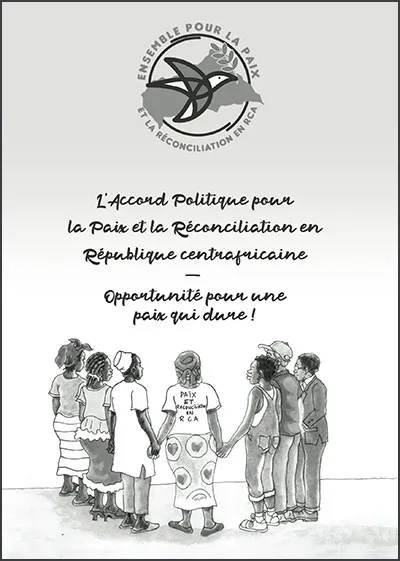


MINUSCA supports the implementation of the Political Agreement for Peace and Reconciliation in the Central African Republic (APPR-CAR), signed on 6 February 2019, as well as the commitments stemming from the Luanda Joint Roadmap, adopted on 16 September 2021.
Since 2025, the Mission has also supported the implementation of commitments arising from the N'Djamena Agreements concluded between the Government and the armed groups Union for Peace in the Central African Republic (UPC) and Return, Reclamation and Rehabilitation (3R), signed on 19 April 2025, as well as the agreement with the Patriotic Movement for the Central African Republic (MPC), signed on 19 November 2025, which formalized the return of these groups to the APPR-CAR.
MINUSCA also supports Government efforts to strengthen the effective decentralization of the peace process, ensuring coherence between local and national peace initiatives.
The Mission's engagement with the national authorities has contributed to steady progress in implementing both the APPR-CAR and the Luanda Roadmap. This has included regular strategic review meetings chaired by the President (October 2023) and coordination meetings led by the Prime Minister (August 2024), enabling stakeholders to assess progress and address challenges at both the national and local levels.
MINUSCA has also strengthened implementation of the Agreement by supporting existing peace mechanisms, notably the Prefectural Implementation Committees (CMOPs) and the National Disarmament, Demobilization, Reintegration and Repatriation Programme Implementation Unit (UEPNDDRR).
Decentralizing the Peace Process
MINUSCA's support for the decentralization of the peace process delivers tangible benefits to communities and contributes to long-term stabilization.
Through technical and logistical assistance, the Mission has enabled the Prefectural Implementation Committees (CMOPs) to carry out around 50 activities annually across the country's 20 prefectures.
Training and capacity-building initiatives have strengthened the operational effectiveness of the CMOPs and enhanced their ability to respond to local challenges.
The Committees help resolve intercommunal disputes, facilitate dialogue, reduce community violence, prevent local conflicts, support locally negotiated agreements, raise awareness of the peace process, mitigate transhumance-related conflicts, support disarmament and reintegration efforts, and promote reconciliation and social cohesion. They also strengthen coordination among local authorities, demobilized armed groups, religious leaders, civil society organizations, youth, and women.
Promoting the Peaceful Management of Transhumance
The peaceful management of transhumance has become one of MINUSCA's key stabilization priorities, implemented in close coordination with the Central African Government and national and international partners.
This momentum was initiated through the High-Level National Conference on Peaceful and Prosperous Transhumance, organized by the Government with MINUSCA's support in May 2024. Bringing together national institutions, local authorities, civil society, farming and pastoralist communities, the conference produced key recommendations for implementing the transhumance-related provisions of the Political Agreement for Peace and Reconciliation (APPR).
Between October 2024 and June 2025, 36 regional conferences were organized across the country's 20 prefectures, bringing together sectoral ministries, prefectural and sub-prefectural authorities, defence and security forces, and local communities. These consultations identified the main risk factors—including non-compliance with transhumance corridors, cattle theft, unauthorized crossing points, and the presence of armed groups—and promoted preventive measures based on mediation, community dialogue, and local governance. They also strengthened the role of Transhumance Working Groups (TWGs), Local Peace and Reconciliation Committees (CLPRs), and Prefectural Implementation Committees (CMOPs).
MINUSCA also carried out mediation, economic resilience, and dialogue initiatives between farmers and herders, reaching several thousand participants. These activities helped reduce tensions, protect livelihoods, and strengthen peaceful coexistence between communities, making transhumance management a practical pillar of peacebuilding and stabilization in the Central African Republic.
The Mission also provided motorcycles to local peace mechanisms to improve their mobility and responsiveness.
Supporting Community Radio Stations
MINUSCA strengthened the capacities of 28 community radio stations, helping improve access to reliable information and counter disinformation.
These radio stations have had a direct impact on communities by promoting access to accurate information, preventing tensions, and encouraging civic participation.
They also played a key role during the electoral process by providing civic education, promoting peaceful participation, and facilitating inclusive political dialogue at the local level.
>> L’ACCORD POLITIQUE POUR LA PAIX ET LA RÉCONCILIATION